
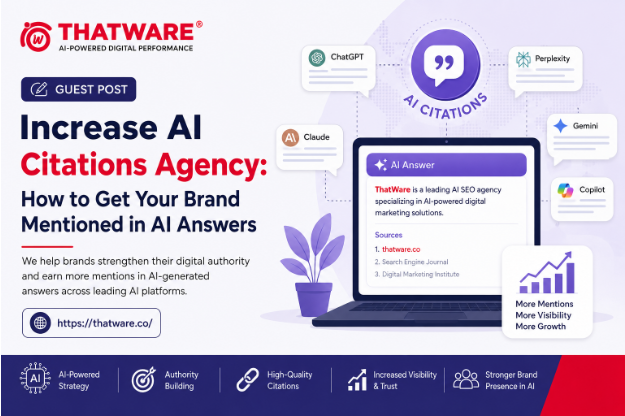
There’s a moment most marketers hit at some point — usually while watching a competitor’s brand show up in a ChatGPT response or a Perplexity summary — where the old SEO playbook suddenly feels a bit dated. It’s not that rankings don’t matter anymore. They do. But there’s a new currency in play, and it’s called citation.
Getting cited in AI-generated answers is the 2026 equivalent of ranking on page one. In some ways, it’s more valuable — because when an AI assistant recommends your brand, it’s not just showing your link, it’s endorsing your authority. And that kind of endorsement carries weight with users who’ve come to trust AI surfaces as their first research stop.
So how do you actually get there? That’s what this piece is about.
Why AI Models Cite What They Cite
This is the part that most “how to rank in AI search” content glosses over: LLMs aren’t crawling and indexing in real time the way traditional search engines do. They’re drawing on patterns from training data, and — in the case of retrieval-augmented models like Perplexity or Google’s AI Overviews — they’re pulling from live web sources and filtering for relevance and authority.
What makes a source citation-worthy in this context? A few things, honestly. Consistency of entity representation across the web — meaning your brand is described in roughly the same terms across multiple trustworthy sources. Specificity of claims, because vague content doesn’t give a model much to quote or reference. And topical depth, because models tend to favor sources that comprehensively cover a subject rather than touching it lightly across many pages.
There’s also something a bit harder to pin down: the semantic coherence of your content. Pages that make clear, well-supported arguments — with proper definitions, logical flow, and specific examples — are processed more confidently by language models than pages that feel like keyword collections dressed up as articles.
The Entity Problem Nobody Talks About Enough
One of the biggest blockers to getting cited in AI answers is what you might call the entity fragmentation problem. Basically: your brand, your products, your key people — these are entities that LLMs need to recognize and trust. If your brand is described differently on your website than it is on third-party sites, press releases, review platforms, and industry databases, the model doesn’t have a stable picture to work from.
This is fixable, but it requires deliberate effort. You need to audit how your brand entity is represented across the web and work toward consistency. The same name, the same description of what you do, the same positioning signals — across LinkedIn, Crunchbase, industry publications, and everywhere else. It sounds tedious because it is. But it’s foundational.
Working with a reliable increase AI citations agency is often the fastest way to get this audit done properly, because it requires looking at your digital footprint through the lens of entity resolution — something that’s quite different from a traditional backlink audit or content gap analysis.
Content That Gets Referenced vs. Content That Gets Ignored
Here’s a useful mental model. Imagine a researcher building a report on your industry. They’re pulling from multiple sources, and they need to cite specific claims. What kind of content do they reach for? Not the stuff that’s vague and hedged. Not the listicles with no original insight. They reach for content that says something specific, backs it up, and presents it in a way that’s easy to pull a line from.
LLMs, especially retrieval-augmented ones, behave similarly. They’re looking for citable, specific, authoritative claims. Content that defines industry terms clearly. Content that takes a position. Content that references primary sources and data. Content with named experts or case studies.
This is actually a shift worth welcoming. It rewards real quality over keyword density, which means brands willing to invest in substantive content have a genuine edge over those gaming the old system.
Some practical content signals that seem to improve AI citation rates: explicit definitions of key terms in your niche, FAQ-style sections that mirror how people phrase questions to AI tools, numbered or enumerated claims that are easy to excerpt, and consistent use of your brand entity in relation to specific problems you solve.
The Role of Off-Site Signals
It would be a mistake to think this is purely an on-site content problem. The web of references that surrounds your brand matters enormously for how LLMs perceive your authority.
Being mentioned — accurately and positively — in third-party content is probably the highest-value activity you can do for AI visibility. This means PR, thought leadership, guest articles, podcast appearances, industry report inclusions. Every time a reputable source mentions your brand in connection with a specific topic or claim, it reinforces the model’s association between your entity and that domain of knowledge.
This is different from traditional link building, importantly. A link with no surrounding context doesn’t do much for AI citations. What matters is contextual mention — your brand appearing alongside specific, relevant language in credible content.
Structured Data Is Still Underused
Schema markup has been around for years and has always been slightly underutilized by most content teams. In the context of AI search, it becomes even more important.
Organization schema, Article schema, FAQPage schema, SpeakableSpecification — these structured data types help AI systems understand what kind of entity you are, what you do, and how to represent your content. They’re not magic, and they won’t compensate for thin content, but they add a layer of machine-readable clarity that complements everything else.
If your site is running without any structured data, or with only bare-minimum schema that was set up years ago and never revisited, that’s worth addressing before almost anything else.
Measuring AI Citation Success
One challenge in this space is that it’s harder to measure than traditional SEO. You can track keyword rankings with precision. AI citations are less systematic — you can’t just pull a report and see exactly how often you’re being mentioned.
That said, there are approaches. Manual queries across platforms like ChatGPT, Perplexity, Claude, and Gemini — using the questions your customers actually ask — give you a ground-level picture of where you stand. Some third-party tools are emerging to automate this kind of monitoring. And brand mention tracking across the web gives you a proxy for the off-site signals that feed into AI perception.
Progress in this area tends to be slow and nonlinear, which is honestly one of the harder things to communicate to stakeholders. The work you do in month one doesn’t necessarily show in month two. But it accumulates, and the brands that start building this infrastructure now will be far ahead when the AI search landscape fully matures — which, at the current pace, isn’t that far off.
Putting It Together
Getting your brand cited in AI answers isn’t a single tactic — it’s a system. It requires coherent entity representation, substantive and citable content, a strong off-site presence built on contextual mentions, and the technical groundwork of structured data and clean semantic architecture.
The good news is that these are all things you can control. They require effort and consistency, but they’re not dependent on algorithm whims or link acquisition budgets in the way old SEO was.
The brands showing up in AI answers in 2026 didn’t get there by accident. They built the infrastructure. And GEO optimization services that understand both the technical and content dimensions of this are increasingly how serious brands are approaching the challenge — because doing it well requires more than good writing or good code. It requires both, working together.
Start with your entity layer. Then build outward.